You REALLY Can’t Reboot Character

So after writing about Star Trek – Into the Darkness without having actually seen it, I finally went to see it, and boy was I right. Who are these people? You really can’t reboot character.

What follows is a rant, which should not read by anyone who has not yet seen Into the Darkness, but intends to:

I get that JJ Abrams is trying to create a “new” Trek, but then why doesn’t he just throw in a new captain and a new crew and give them another part of the galaxy to explore? Instead he’s turned McCoy, Chekov, and Sulu into near parodies of the originals, and given us an Uhura who bears no resemblance to the one we know. I do not recognize any of old Kirk in new Kirk, and I’m not talking about Shatner’s unusual phrasing. I understand Abrams’ Kirk is different. He grew up in a different timeline without a father. It made him more rebellious and “angry,” a kind of a rebel, which is how we first saw him in the original reboot – driving a souped up convertible like James Dean. Roddenberry’s Kirk was a boy scout compared to him. Zachary Quinto is somewhat more successful at giving us a recognizable Spock, but this Spock is rudderless. He’s lost his parents and his planet and somehow carries the Continue reading You REALLY Can’t Reboot Character

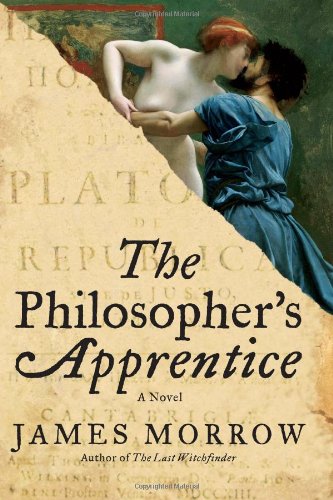
Your Saturday Book Review — The Philosopher’s Apprentice

After hearing an interview on NPR with author, James Morrow, I went to a bookstore (Remember those?) to search for a copy of his then new novel, The Philosopher’s Apprentice. I couldn’t remember the title, but when I described the plot – teacher, remote island, mysterious happenings — the clerk thought I was talking about The Magus, a book which bears almost no resemblance to this one. The Island of Dr. Moreau would be getting warmer.

The island here is off the coast of Florida, the teacher a brilliant philosophy graduate student who has just blown his thesis on principle. . He is offered a job by a billionaire scientist who tells him her teenage daughter was in a diving accident and suffered damage resulting in the loss of her moral conscience. His mission is to guide her in developing a sense of ethics. It’s an offer too tempting to refuse, especially given the $100,000 salary. Of course, once he arrives, things aren’t what they seem and yadda, yadda, yadda.

Most of the action takes place years after the island sojourn when his pupil has made her way into the world, intent on changing it.

While the book clearly falls into the sci-fi genre, the author is after bigger fish, taking on bioethics and religion with satiric aim. Whether or not he succeeds may be subjective. The better-half felt Morrow went too far and sometimes missed the mark. (Several reviewers agree.) But I found the story entertaining and thought provoking throughout though at times Morrow’s reach may have exceeded his grasp.

While a knowledge of western philosopher (among other things) is not a necessary prerequisite to the enjoyment of the book, it couldn’t hurt. It’s certainly worth checking out especially for well-read fans of satire.

(Apology: I have been slow on getting these reviews out and didn’t post last week. I guess I’m kind of depressed because my own books haven’t been selling lately. Check them out, why don’t you?)

5 Simple Steps Amazon Could Take to Improve Reader Experience

The quality or lack thereof in self-published e-books has been the topic of many a forum thread over at the Amazon sites, and many other places on the web. Customers have complained about lack of editing, and general shoddy quality, including bad formatting. When anyone can “publish” a “book” on Amazon’s free digital publishing platform, many bad books will be published, leading most readers to avoid anything that smells self-published – even when the download is free.

Here are five simple steps Amazon could take to improve reader experience with self-published works:

    5. Stop allowing uploads to the Kindle platform using Word. Word is buggy and formatting errors are likely to occur. Most savvy writers are uploading from HTML. Allowing Word uploads is asking for formatting problems. It’s not too much of a hurdle for writers to convert to HTML, or read a formatting guide explaining how to do this. Writers who lack the technical “expertise” can easily find someone (a grandchild perhaps) who can figure it out.
    4. Format Check. Related to above – Have a program that reviews formatting and automatically stops badly formatted work from being accepted for publication. It only needs to be sophisticated enough to differentiate purposeful playfulness from complete messes, including scans supplied by rip-off vanity presses like Publish America and Author House.
    (In fact Amazon needs to crack down on companies like Publish America which publish unproofed and badly formatted manuscripts on Kindle and then charge their authors for “corrections” and to get back their publication rights. These practices don’t simply rip-off authors, they leave Amazon customers unsatisfied, and may turn off customers.)
    3. Use an advanced spelling and grammar check. Sure one would imagine that any manuscript being uploaded has been proofread a number of times, and that  all manuscripts have been through simple automated checks. However, this is not always the case. Amazon is now experimenting with a spell check that gives the author feedback about possible errors after they submit a manuscript to Amazon’s “preview” feature. This may help, but I’m not sure how good it is at spotting wrong words, grammar issues, punctuation problems, and other technical errors. Nor will any automated system work on fiction where authors may purposely use phonetic spelling or bad grammar in dialogue or for other purposes – not to mention sci-fi and fantasy where entire new languages may be created. However, Amazon should continue to develop the feature, and require publishers (whether they are micro-presses or individuals) to “sign-off” that they have actually viewed the feedback, and anything being left uncorrected is intentional.
    2. Book length and pricing: Right now any length is acceptable for a Kindle book, and many bestselling Kindle books would be too short to sell in print as a stand alone book. Recently, many authors have begun uploading single short stories, including short-shorts. Nothing wrong with that, except they’re mixed in with full-length books by genre, leading to some consumers feeling “ripped off” when they discover they’ve just purchased a 1,000 word work. Amazon has introduced a “page count” feature for e-books to help make consumers more aware of what they are getting. That’s great. However, the flood of short works still makes it difficult to sift through if you are looking to buy something that takes more than an hour to read. Here’s a simple suggestion – novels and even novellas and short story collections of at least 20,000 words are books. Anything less than that is a mini-book, or a short, or a single or whatever you want to call it, and should be somehow separated from full-length works, and clearly labeled. Price limits on shorts would be a good thing. Amazon prices its own “singles” imprint at less than full-length book prices, so why shouldn’t independent authors be subject to these controls?
    1. Help consumers find quality self-published work that will appeal to them. Amazon already has many proprietary secrets for targeting products to customers. They also have started several of their own imprints to help promising work get attention. But with so many books being uploaded every day, more filters are needed. A couple of months ago, I wrote a post on how Amazon could use paid readers to find self-published work likely to appeal to target audiences. The short version is that Amazon should offer an option for writers willing to pay a reading fee. The reader should be a consumer who falls into the target audience for the book. The writers would have receive a genuine reader review, and the reader could either “approve” or “reject” the book. Amazon would have a browse feature for approved books, and might promote them in other ways.  (Rejected books could still be self-published without “approval.”) This would give self-published authors a legitimate, objective review at a lower price than Kirkus or other services charge. It would be more relevant to Amazon readers since the reviewer would be one of their own and not a paid review service. It would help readers find books they are more likely to enjoy.
    (Like this post? Why not check out more on this blog, or take a look at Marion’s books?)

Your Saturday Book Review — TBR

Another week that I didn’t read a book. But I pledged to write a book review every week, so what to do? I could do what I’ve been doing and pick a book I read at some point in the past, but that’s gotten old, so instead I’m going to be completely self-indulgent because it’s not like anyone I don’t know actually reads this blog, and I’ll discuss some of my to-be-read-books because not knowing anything about a topic has never stopped me before. I will not, however, be really funny, like that lady who’d never seen an episode of Lost.

Small Crimes in an Age of Abundance – This is a DTB that the better-half insists I read. He keeps saying stuff like, “You haven’t read it yet, have you?” I get the feeling that his dream girl has read it already, and they have lots of great imaginary discussions about it in their bed of roses. I can see why it appeals to him. Per the blurb, it’s short stories about “ordinary people” set in many different parts of the world. Per the review excerpts, the stories are “darkly funny” and “highly entertaining.” I get the impression they have edge, so if you like edge, this may be for you. If you like brands, it’s published by Picador, an imprint of Macmillan aimed at the international high-brow market.

There are also several “indie” books waiting to be read on my kindle. I here and now pledge to Continue reading Your Saturday Book Review — TBR

The Office — Escape from Scranton

When the American version of The Office first appeared, it was condescending in a Hollywood way, written by people who may have once, briefly, worked in a setting similar to Dunder-Mifflin, but always believed they were destined for better things, and got the hell out as soon as they could.

Over time, however, it became habit-forming. Steve Carrell made Michael Scott’s need to be loved idiosyncratic, terribly funny and somehow a reflection of everyone’s inner-narcissist. Contrary to rumor, he was not the terrible boss we’ve all had. He might have shared some traits with bad bosses, but most truly horrific employers want to be feared, not loved. There was also, of course, Jim. From the beginning Jim, and to a lesser extent his beloved Pam, were our surrogates. They were young.  They were not weird. They were more than their jobs, and they fell in love. Communication was not great. It took Pam a while to see what should have been obvious.

Other characters also developed into full-fledged human beings although it took some longer than others. Angela, the office mean girl, needed to be taken down a few dozen pegs before we could consider liking her. As for Oscar, if I’m not mistaken, until the last couple of seasons, he seemed mostly to be there as two-fer, and to make Michael’s jokes that much more embarrassing. Dwight remained eccentric, but matured. Andy’s arc was the strangest. He started out as Continue reading The Office — Escape from Scranton