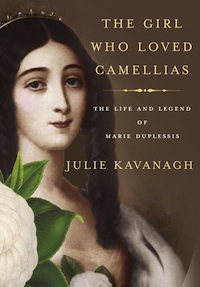
Your Saturday Book Review — The Girl Who Loved Camellias

As far as I know, Julie Kavanagh’s The Girl Who Loved Camellias is the only full-length English language biography of Marie Duplessis, a name that few Americans would recognize. The author herself mentions her need to study French in order to read what other writers had to say about Marie, including several who met her. The problem is that few of her letters survive and she kept no journals or diaries that anyone is aware of, so what we know about Marie is always based on how others saw her and remembered her.

In her lifetime, she was a well-known courtesan – a fashion tend-setter who could often be seen at the theater or at her box at the opera, a woman whose name was mentioned in whispers. While she wasn’t invited to the places where she might mingle with “respectable” women, her home became a salon to some of the most well-known and accomplished men. If she is remembered today it is primarily as the woman who inspired the opera La Traviata and the Greta Garbo movie, Camille. Of course, long before Anna Netebroko put on that red dress, there was a novel, La Dame Aux Camilias, written by a young man with a famous name – Alexander Dumas fils. When the novel came out, shortly after Marie’s death at age twenty-four from “consumption,” it was viewed as an account of their relationship, though Dumas admitted that much of it, including the idea of the whore with a heart who makes a great sacrifice for “love” was pure fiction. Once the play of the same name became popular, Marie as Marguerite Guatier belonged to the world.

While the book is heavily sourced, Kavanagh quotes often from the Dumas novel and play, even though these are both fictional portrayals. The author sometimes speculates, for instance wondering if the close relationship Marie had with another courtesan had a “sapphic” character, but also telling us that if it did, Marie would have kept that to herself. Later Kavanagh imagines that a “friend,” who was said to have been staying with Dumas while he was writing his book, might have been another of Marie’s lovers, and the true inspiration for the character of Armand, but she offers no evidence that Dumas was more than causally acquainted with that particular rival.

The book is useful for learning about Marie’s milieu, the demimonde, and its interaction and connection to the larger world. There is no modern-day equivalent of the great courtesans. These were women who were celebrated and known. They were independent operators who could choose their alliances, at a time when women had few choices. Unlike the ladies who could not be present when men gathered to speak frankly of ideas, politics and even art, women like Marie were expected to be there and participate.

But there are mysteries at the book’s core which are never solved. How did uneducated, abused Alphonsine Plessis manage to transform herself into the glamorous and wealthy Marie Duplessis? That is, we know who kept her and have the dates, but why her? What was it about her in particular? It’s hard to know how Marie actually “felt” about anything. She was known to lie, having once quipped, “I lie to keep my teeth white.” Often people who knew her wrote entirely different versions of the same events. So while Kavanagh manages to fill in some blanks, we are left with an empty space at the center, and the question remains: Who was Marie Duplessis?

This is a new release and a bit pricey. The Kindle version is $13.99, and the hardcover is on sale for over $16. There’s no paperback yet. If I wasn’t especially interested in the subject of the biography, I would have waited for the Kindle price to come down or reserved it from the library

Courtesy — It Works!

Per a recent CNN blog: In response to customer complaints, Whole Foods is enforcing an English only policy during work time on employees, in – of all places – 47% Hispanic New Mexico.

Whole Foods is known for being staunchly anti-union, so this is no surprise, but before going all politically correct regarding the language issue, is it possible that both sides of this “debate” are missing an important point?

I get why employees want to be able to speak the language they are most comfortable in to each other, and why most Spanish-speaking people are resentful of “English only” anything — especially in a place like New Mexico where many residents are quite proud of their heritage.

I understand why customers aren’t comfortable when employees are speaking in a language they don’t know. Their reasons include statements like: “My grandparents came to this country and they had to learn English.” That may not be particularly rational, or even historically correct – said grandparents may have come from an English speaking country, or they may never have actually learned enough English to get by without help. There might even be an underlying prejudice, and there’s a limit to “the customer is always right.” Sometimes the customer may ask for something that clearly is not right, as in “Fire the girl with the headscarf or I won’t come back.” Assuming the headscarf, and not job performance, prompted the complaint, the correct answer from management would be, “We’ll miss your business.”

But the “English only” crowd may have other reasons besides “English is the official language of these United States” which is not a true statement no matter how often it’s said. They may feel like people are talking about them when they can’t Continue reading Courtesy — It Works!

Your Saturday Book Review — No Earthly Notion by Susan Dodd

It’s unlikely you’ve heard of No Earthly Notion by Susan Dodd. It’s a short novel published in 1987. Long ago I happened upon the Penguin, Contemporary American Fiction paperback. If ever there was a publishing brand you could trust, Penguin, Contemporary American Fiction was it.

The protagonist, Murana Bill, is left orphaned when her parents are killed in a train wreck and she is just old enough to take on responsibility for her younger brother, Lyman Gene. She sees him through high school. He joins the army, and then returns from Vietnam, more in need of her care then ever before. To tell more of the plot would diminish your joy in reading it, so to put it simply, this is a novel where not much happens, but we, as readers, are made to connect with Murana, a character whom in “real life” we wouldn’t even see if she were right in front of us.

Kirkus found it “soddenly sentimental.” There’s a touch of Southern gothic about it as well. After Lyman Gene’s return his only pleasure is food and Murana feeds him. The people that Murana gets close to all have a way of dying off. In the hands of a lesser writer, Kirkus‘ verdict might be correct, but Dodd saves her story by employing a stylistic minimalism that says more with less, and shows both restraint and control. Dodd is unsparing in her portrait of Murana, and avoids sentimentality by staying true to her character. There’s no sudden transformation, no easy solution. This isn’t about a woman losing three hundred pounds, or an ugly duckling turning into a swan. It’s about baby-steps, which in themselves are both ordinary and miraculous.

The last line of The Office series finale was “There’s a lot of beauty in ordinary things.” That would make a fine epitaph for this novel as well.

Availability: Not on Kindle, but you can find it new and used starting at $0.01

This Is What a Family Looks Like

So, I will now be watching two “young adult” shows on ABC-Family. Switched at Birth was a guilty pleasure that turned out to be a justifiably great show.  The summer premiere is next week. Yay! The Fosters, is a new family drama, with a too-cute name. It’s the story of a family, two moms, the biological son from a previous relationship, two adopted kids and the new foster girl. The way I figure it, if it pisses off the so-called “One Million Moms,” it deserves a chance. That’s why I shop at JC Penney.

Having briefly worked on the outskirts of the foster care system in Vermont, I find the premise not unrealistic. I’ve met families like these – adults who’ve built families by taking in kids that need them, and often spend their working lives serving the community as well. In this case, one mom is a cop, and the other a vice-principal at the bestest charter school ever.

The pilot throws a few curve balls. One mom is black, the other white. The adopted kids are Latino twins – Jesus and Mariana. Jesus takes medication, and though it’s not stated, it seems to be for ADHD. Mariana is “the good one,” but she has some secrets. Brandon, Stef the cop’s biological son, is a talented musician, the oldest, and an understated hottie. His girlfriend is a bit uh possessive, or maybe just a run of the mill mean girl. All of them go to a magical charter school on the beach (!) where teachers go by their first names, and the cafeteria is probably organic. Callie, the new girl, was recently sprung from  juvie, but by the end of the pilot, we find out she landed there trying to protect her cross-dressing kid brother. And just to throw more into the mix, for no good reason, other than “family drama” Stef’s new work partner is her ex-husband, Brandon’s father.

The acting is good, and the writing has a bit of depth. I was impressed by one scene with Stef’s boss, where a bunch of stuff about their relationship — including its boundaries, was nicely implied. That had to have been thrown in for the adults. Nice touch.

I wonder if they’ll make having two moms seem as cool as being deaf? All I know is if I were Callie and I landed at that school, I’d do just about anything to stay. At one point, Stef talks to Lena about making space for the growing brood and says, “We’re not The Brady Bunch.” But really, given how functional this blend is, they aren’t very far from it.

I’d say ABC has another show families can watch together, and even olds like me can enjoy. If you don’t have cable or missed it, you can check it out here, free and legal, and/or watch this trailer:

(Enjoy this review? Isn’t it strange that Marion, who loves these sappy television shows writes hard-hitting transgressive fiction?)

Awwr Matey! How to End TV Piracy

Stumbled across an article in Forbes from back in April, referring to a New York Times columnist’s confessing to illegally using someone else’s HBO-Go password to watch the premiere of Game of Thrones. GOT is known as the most pirated show on television.

I know piracy is prevalent, but I wonder how much of it comes from people with cable who just aren’t paying for premium channels.  How many people who would have subscriptions forgo them in order to stream or download illegally? I don’t imagine too many families or even groups of roommates sitting around someone’s tablet searching for a none “broken” illegal link to a program. If you’ve got a cable television subscription, it’s not a big deal to add a premium station or two.

The real issue is that more and more people are choosing to opt out of watching “television”  the old-fashioned way, and are now watching exclusively through the Internet. Most network shows are available albeit with commercial interruption free the day after they are initially broadcast.

Some shows do have to be paid for. AMC offers episodes of Mad Men and The Walking Dead through Amazon for $1.99 an episode. Viewing legally means not having to worry about picking up malware and viruses, or deal with pop-up ads and other annoyances. This in addition to its being both ethical and legal. I’m sure people use illegal sites to watch AMC offerings anyway, as some people just can’t wait until the next day or love the idea of getting something for nothing, but my guess is that there is less stealing going on proportionally than for HBO. This is because neither HBO nor Showtime offer an option for non-subscribers to watch current programming legally. You can get a cable or satellite television subscription or you can wait a year or so for the disks.

If HBO-Go offered services to people who don’t have cable television, or allowed one-time streaming of current episodes for a per episode fee, they’d be able to cut down substantially on theft. If all channels offered access to their shows at the same time as they are broadcast, they could probably defeat the pirates and make more money.

The premium stations wanted to make Internet-only subscriptions available, but the cable companies prohibited it. Runaway piracy of popular programs is a by-product. Understandable that these dinosaurs want to put off extinction for as long as possible. But how long until everybody gives the boot to cable television as we know it? The cable companies are like the publishing houses and bookstore chains of a few years ago, dismissing e-books as a fad when they should have been figuring out a new survival strategy.

(Enjoy this post? Marion’s books are so cheap, you don’t have to pirate them!)