Your Saturday Book Review: Pagan Babies — Not the Band

I am now 14% (per my Kindle) done reading A Naked Singularity.

I so want to love this book — a self-published long-shot by a first time novelist that became an authentic underground hit — but so far it’s mostly working as a soporiphic. The sound of it is brilliant. De La Cava doesn’t just have an ear, he is an ear. The characters are colorful, and while many are from the lower-depths, none feel stock. The protagonist a likeable enough sort. But so far I’m not compelled by the narrative itself. I keep waiting for it to start….

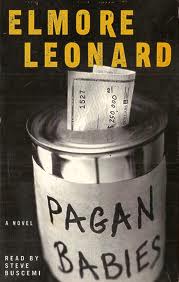
So meantime because I promised (myself) to write about a book every week, this week will be another that I’ve read some time ago – Elmore Leonard’s Pagan Babies.

I can hear the groans now. Elmore Leonard??? Really? Isn’t he a little low-brow, and not low-brow in a high-brow way like Patricia Highsmith or Cornell Woolrich?

The fact is that Leonard, even in his weakest books (and a couple read like he was just riffing for an hour while someone typed) is still unmistakeably Leonard. He may rehash characters (sometimes with different names) and similar schemes come up again and again, but the man has skills. He knows how to “leave out the parts that people skip.” The prose is always in motion, and however thin the plot, it is always in plain sight, propelling the action.

If you’ve never actually read Elmore Leonard’s work, but have already decided you won’t like it, just because, think again, and if you don’t start with Get Shorty, Out of Sight or Rum Punch, all of which were made into fine motion pictures, than you might start with Pagan Babies, Leonard’s sort of foray into Robert Stone territory.

The babies in the title are Rwandan orphans and the book gives a quick and accurate account of the genocide, which takes place prior to the events in the novel. Terry Dunn is a priest in a village, having taken over from his uncle the previous priest who died. Like many Catholic priests in the developing world, he lives with a woman, and drinks. He heads to America to raise some money for the orphans, and also because it might be a good idea for him to get out of town, and finds himself drawn into a scheme involving a lot of types particular to the Leonard-verse.

It’s an entertaining, quick read (even at 334 pages) and the only book by Leonard I know of which takes on anything as serious as Rwanda, even though most of the action takes place stateside, and is not in any way serious.

(Marion has more book reviews on this blog, and you can check out her fiction here.)

What the F**k is wrong with people? Part 10,012.

So a couple of nights ago, the better-half and I go to see Alan Cumming in MacBeth. There’s only a few performances left, and this is not a review, but here are a few observations:

  • That Shakespeare guy, we all owe him for inventing the language: sound and fury, dagger of the mind, be-all-and-end-all, a poor player that struts, milk of human kindness, something wicked this way comes, sorry sight, etc. And that’s just one play!
  • Because of the concept, it helps to brush up your Shakespeare – specifically the basics of the Scottish play although the Playbill offered helpful notes.
  • It was thrilling and unexpected to see theater this alive on Broadway.
  • Alan Cumming was brilliant.

There are two other actors on stage at times, but mostly, this is a one man show, with Cumming playing everyone but Banquo’s ghost. That’s a lot of acting, and it feels both amazingly fresh and original, and also somehow retro – reminding this viewer of the old-timey (1980s) monologists who could fill the stage with distinctive characters, all embodied by a single being. And he doesn’t have to do this either. He’s a television star now with a regular paycheck. He’s there for us. We ought to show him some respect.

Which is why once I was back out on the street, I began to rant.

See here’s the thing:  Showtime is at seven. That’s what it says on the ticket, and Tuesday nights most non-musical plays start at 7:00. Remember this is one guy (mostly) on stage for 100 minutes straight. Not only isn’t there an intermission, there are really no “breaks” in the usual theatrical sense. So basically once it starts, there is no point at which latecomers could enter the theater without disrupting other audience members, and possibly Mr. Cumming himself.

And yet….

People seemed to trickle in for a good twenty minutes, accompanied by ushers leading them to seats, which meant people had to move and stand to make room. Some of these assholes (and I use the word because they are) had seats in the first few rows where it is not unlikely their presence could be felt by the players strutting their stuff.

Maybe you’re an idiot who assumed the curtain was at eight. Maybe you got stuck at the office. Your train was late. Your cat died.

I don’t care.

If you can’t get there on time, please stay home.

Another thing: When did it become permissible to have a snack while watching live theater? Five minutes before the lights dimmed, there was actually a concessions guy walking through the orchestra section hawking his wares. And during the performance, the sound of chewing could at times be heard accompanying the Scottish burr onstage.

I blame cell-phones. Not that I heard any. People did seem to heed the electronic device warning, at least within my hearing, although some pork-pie hat, soul-patch type two rows in front of me was standing and texting right up until the lights dimmed. I mean, I blame cell-phones for being the greenhouse gas of global narcissism, although it probably started before that, maybe with walkmans and oblivious joggers tuning out other pedestrians as they occupied their own private space in public.

I also blame the management of the Ethel Barrymore Theater for not managing this. Are they afraid if they don’t let the latecomers in they’ll make trouble? Are they so hard up for cash they need to sell concessions before the show begins, afraid they are somehow being cheated because no intermission means less money? Or is it just that they’ve accepted we’ve all become such big wah-wah babies that we are incapable of getting someplace on time and cannot go without snackies for more than two minutes? Maybe they were passive-aggressively hoping to provoke Cumming into pulling a Lapone?

Why can’t Broadway be more like the Metropolitan Opera? You don’t see this shit at the Met. First off, the other patrons would beat the crap out of anyone creating a disturbance, and by disturbance I mean shifting too loudly in your seat. Second, the Met just doesn’t play that. They lock the doors when the orchestra starts. They put the latecomers into a special room of shame, in which they must stay, maybe forever.

They check your bags when you walk in the front door, and the ushers give you the once over before you get to your seat. They’ll grab any food they see on your person and feed it to the homeless.

Have I turned into a bitter old coot yelling at people to get off my lawn? No, I have not. I don’t have a lawn. I live in a city with a lot of other people, and space must be shared, which means no one gets to act like they are in their own living room. No one. I don’t care who you think you are, who you work for, what you paid for your ticket, or how very educated you are. People have to look around and get it through their thick skulls that other people exist.

End rant.

(Enjoy this? There are plenty more rants on these pages, and you can see more of Marion’s work here.)

Dexter Season 8 Premiere — Matthews Pulls the Strings

The first episode of the final season of Dexter is upon us, so I say, let’s all state our theories now. A good twist is one that most people won’t see coming, but it doesn’t come out of the blue. When it arrives, the viewer will not scratch his head and go, “Huh?” but lean back and say, “Of course.”

While some fans are certain Dexter’s decline began with Julia Stiles, it was Rita’s death that caused a tone-change. In place of the dark humor and occasional satirical jabs, we were suddenly meant to take this seriously. Dexter’s “lifestyle” had consequences. Innocent people we’d grown to care about (even if they were incredibly obtuse) were in danger. Season Five, with its his and hers matching kill outfits, quasi-religious self-help-murder-cult, and over the top misogyny, was an honest attempt to get us back where we belonged.

Then came the catastrophic Season Six and the transitional Season 7. It was in Season Six that Dexter’s internal monologues became deadly dull. Gone were the little asides that gave us a peek into his darkly dreaming mind, placing us in the backseat on a drive with Dex and Harry. No more experiencing the glitz of Miami as “Dahmerland.” Now his inner voice seemed to be providing an ongoing narration of his every waking moment. Its purpose was to tell us exactly what he was thinking because we could no longer get that from the writing or the acting, and needed to be diverted from figuring out “the truth” about the professor. Dexter was dumbed down, and we were expected to be in the dark as well. The whole season turned out to be leading up to the one big moment when Deb sees Dexter in the church.

Season 7 only existed to get us to the shipping container confrontation between Dex, Deb and LaGuerta. Anything else that happened was forgotten.

Now here we are in the home stretch. Sunday night’s final season premiere, It’s a Beautiful Day. Thankfully, the writing was tighter than it’s been for a couple of years. While picking up where they left off was necessary after the Season 4 and Season 6 finales, it limited where the story could go. Starting Season 8 six months later, was a smart choice. Deb’s leaving Continue reading Dexter Season 8 Premiere — Matthews Pulls the Strings

Mad Men Season 6 Finale — Wherever You Go, There You Are

If living a lie is killing you, and you make your living by lying, where does that leave you?

We started the season with Don reading The Divine Comedy, and it’s felt like a slog through hell. The preacher who gets kicked out of the whorehouse had a point – maybe the worst thing is not believing that God can forgive you — that change is a possibility, redemption possible. It’s as good a definition of hell as any.

Certainly, the starting place for many in recovery is belief – if only in some kind of abstract power greater than yourself. Maybe, just maybe, Don is getting there. Maybe a god with a sense of irony set up the other preacher – the asshole in the bar who makes the remark about RFK and MLK Jr– in order to provoke Don into finally punching him. What better way to hit bottom, than to do it while finally standing for something? Remember after MLK Jr had been killed, when Megan and Sally went to a rally, while Don stayed home and then took Bobby to the movies, and both the women gave Don that “what a pathetic excuse for a human” look.

He may have been drunk and disorderly, but at least he was engaged.

So what else happened? None of the carnage we might have feared. Megan is not dead, but the marriage might be – which is not a bad thing, given that Don married her in a desperate attempt to (again) reinvent himself, and when he tried to remake her in his image and failed, he gave up and got into bed with a neighbor’s wife. Sally is not dead either, and after months of alienation, perhaps Don’s moment of honesty with his kids, might be the beginning of their reconciliation although that’s way too neat, fake, and unlikely. The thing that is likely, is that Sally is getting a hell of an education for a future as a memorist or fiction writer.

Ted does the right thing for his family, but still comes off as a douche, leaving poor Peggy to her embittered future, unless she and Stan get a clue, partner up in life and work and start a new kind of agency together.

In the season premiere, we met our first double of Year 6, the soldier about to go to Vietnam. We sense he won’t make it back, but will die as Dick/Don should have. There were tons of other doubles – Jim and Roger, Ted and Don, and of course Don and Bob. The season ends with Benson ascendant and Draper fired. We also see alcoholic Duck, who was fired by Don, walking in to the agency with Don’s replacement. But the biggest surprise surrogate of all is Mrs. Campbell. Don almost runs away to California. Mrs. Campbell takes a cruise. Don creates a campaign with the slogan, “the jumping off point, which features an empty suit left on a beach, and all the clients can see is death. Where’s the body? It’s not Don who vanishes at season’s end, it’s Mrs. Campbell Was she pushed? Did she change her name and start again? Or did she jump? Leap into the unknown?

What will the final year bring? While people may gripe that the show isn’t what it used to be and hasn’t been since maybe the pilot, one of the good things is the way in which it continues to surprise.

Despite the feel-good sentiment of Moon River, one hopes Joan holds her own and doesn’t rekindle her“romance.” with Roger. Joan is all about trying to do the right thing. She fails regularly, but Roger just brings out the worst in her – fooling around with a married man, careless sex on the street while your rapey-husband is in Vietnam, prostituting yourself to save the agency because he didn’t try to stop you. (Joan and Peggy, each with her own career path and path to or away from love, provide another mirror.

It will be a letdown if Don starts going to AA meetings and begins to recover from his alcoholism. Despite the idea woven in that we can all be forgiven, we can’t all just start over. He can’t drop the Draper persona. He deserted the army and stole another man’s identity. There are consequences. He can’t really leave advertising either. There’s nothing else he knows how to do. You need tools and support to fight addiction. He has neither. He drinks because he’s an alcoholic, but he’s an alcoholic in part because he’s self-medicating. Living a lie and lying for a living is stressful, and other than sex, tobacco, and alcohol Don’s got nothing to fall back on. Addiction is a progressive illness. While Don may now be grasping with the beginning of the skill-set for recovery, it’s a bit like a man wondering around the desert who just found enough water to maybe stave off dehydration for another hour.

Your Saturday Book Review — Moses and Monotheism

Since I’m slogging through A Naked Singularity and won’t be ready to review it for at least another week or three, I’m stuck writing about a book I read previously. So this week, it’s Moses and Monotheism by Sigmund Freud, which I think I last looked at sometime before the birth of a niece who just graduated college.

You may have already bounced from this blog, or you may be asking yourself, “Why? Why the hell would I want to read anything by that discredited, misogynist fraud?”

Here’s why: No matter what you think of psycho-analysis, Freud was a hell of a writer. He may have been clueless about women. His take on “penis envy” was likely his own projection based on his being a circumstanced Jewish guy with maybe not the world’s largest genitalia, in the land of the uncut German uber-schwanz. And some of the other stuff may also have been personal, more about him than about a theory that explains everything, but even in translation, his prose is sharp and his voice distinctive. He’s got skills!

Moses and Monotheism is an essay written toward the end of his life (1937) when he was on a crap-load of morphine for the oral cancer that was torturing him, and maybe chasing it down with a little of his old favorite — cocaine. There’s an urgency to the writing that makes it easy to imagine Freud composing it the wee hours of the morning, when even doped up, he desperately needed to distract himself from both the physical pain of his cancer, and the spiritual pain of exile as he watched the world he knew come to an unimaginably horrible end.

It’s a short, tight, highly-accessible work — an essay in which he retells the biblical story of Exodus through the lens of psycho-analysis. It’s a great example of taking a hypothesis and running with it over hills and into valleys, cul de sacs, and labyrinths.

Freud goes through the “baby floating downriver in a the basket” fairytale and posits early on that Moses was an Egyptian, and the myth was needed to hide his Egyptian heritage. Then he follows through with much further speculation based on “If Moses was an Egyptian then ….” He writes of Judaic-monotheism’s being rooted in the proto-monotheism of ancient Egyptian worship of the sun god. Because that was primarily a cult of the royals, Freud further concludes that Moses was not just any Egyptian, but indeed a “prince” of Egypt. He further posits that “if Moses was an Egyptian” of course he would introduce the nomadic people he had decided to liberate,  lead and civilize to the Egyptian custom of circumcision.

He continues to (psycho) analyze biblical passages for their hidden meanings, using his Oedipal theory to conclude that at some point Moses’ “people” rebelled and killed their (father) leader. He sees in the story of Exodus, the cover-up of a great crime.

In terms of how to how to deconstruct a text, create and solve a puzzle, and impose an original new text – it’s a masterful job, and one from which we can all learn. Whether or not any of it is “true” is another matter entirely.