Hey fellow fans of Homeland. Yeah, I know, it’s getting tough as the show heads more and more down a road of true lunacy — also Dana. But in case you didn’t catch this week’s episode, or you want to relive it with some yuk-yuks, go check out my recap over at Happy Nice Time People – the sister site of your Wonkette..
Floors I Have Made
It started, as things often do, with the bathroom. Ours was and still is circa 1957. We had the bright yellow tiles that were the legacy of every apartment in our complex. After years of thinking, “Someday I will renovate,” I realized that day was unlikely to ever come. But I decided I had to do something, so I put up some textured paintable “tin ceiling tile” wallpaper, with textured paintable “stucco” wallpaper on the ceiling, and I used colors that would make the yellow look intentional.
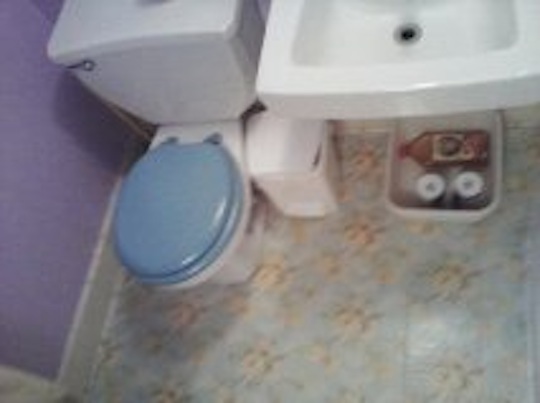 But what about the floor? It had gray, small, plain, concrete tiles. Neutral, but dull. They weren’t going anyplace, so whatever I was going to do would have to go above them, and I wanted something even a novice DIYer could handle. I didn’t think that vinyl planks, even colorful ones, would be an improvement. So I went for more wallpaper.
The internet showed me that I was not insane. Wallpaper floors are a thing. You just have to coat them with enough polyurethane. Think of your hardwood floors. What happens to untreated wood when it gets wet? What happens to your polished floor when it gets wet? You aren’t walking on wood. You are walking on hardened liquid plastic.
I decided on a floral pattern with colors close the ones I’d used. I did not prep the floor in any way beyond a thorough cleaning. I used the “professional” standard wallpaper paste and Vermont Natural water-based polyurethane – a green product manufactured from whey.
How’s it holding up? Continue reading Floors I Have Made

Idiots at the Opera — Eugene Onegin — Why is Everyone Standing So Far Apart?
This will be short, as there’s not much to say about the Met’s current production of Eugene Onegin that hasn’t already been said better by The New Yorker, The New York Times and assorted others.
The Times called the setting drab, and boy were they right. The first act takes place in what looks like a sun room, done up to resemble a sepia photograph from the 1870’s, the period in which this production is set. Everything and everyone looks drained of color, except for a dancer in a magenta dress, but even that harvest presentation lacked the joy it should have had. That’s a shame, because given the overwhelming – we are Russians and we suffer – theme, we could have really used some color.
The music has different emotional tones, including playfulness, but the libretto – unless something has been lost in the translation – moves from somber to depressing. There’s nothing wrong with that, but it’s why good direction is needed to find the nuance and highlight dramatic tension. Anna Netrebko, star that she is, does bring some underlying passion and sensuality to the famous letter scene, in which her character, Tatiana — a shy, bookish, young woman, pours out her love and longing for the eponymous character in a letter, but even here, Netrebko is not helped by the staging. Why is it set in the same room as the opening act? Since she’s up writing in the middle of the night, wouldn’t she be in her own bedroom? And when her nanny comes in, why are they standing on different sides of the stage? That’s a motif repeated throughout the evening – having singers stand really far apart from each other. Was it meant to show us their emotional distance? If that’s it, it was an awkward and self-conscious means of doing so.
There’s a lot of press about what was going on behind the scenes. Deborah Warner, who’d developed the production, which was first staged by the English National Opera in 2011, was unable to work on it in New York. She sent Fiona Shaw – her collaborator, who had to leave due weeks before the opening to fulfill another commitment. That may explain why the staging seemed so off and awkward, and the lack of dramatic coherence. Each act felt almost like a separate piece, with little sense of how characters got from here to there, and the blocking looked like something out of a high school production.
Singing Onegin, Mariuz Kwiecien was in good voice, but didn’t manage to convey the character’s charisma or glamour. Not having seen or heard the opera before, I’m not sure how much was due to the production or underwriting in the libretto, but the staging certainly didn’t help. At a pause, the better half, who’d read the novel (in Russian) in college, was trying to explain who Onegin was to me. He’s prideful and cold. He thinks he was meant for better things. But how the hell could anyone think he’d do better than Anna Netrebko?
Pytor Bezcala shined as Onegin’s friend, Lenski, the suitor of Olga, Tatiana’s sister. Bezcala who is (unbelievably) in his late forties. brings a boyish charm and innocence even to dark roles like Faust and the Duke in Rigoletto. Lenski’s youth and impulsivity is a role that plays to his strengths as both an actor and singer. The highlight of the evening was the aria he sings while waiting for Onegin to arrive on the morning that these two now former friends are to duel. It’s a beautiful piece filled with nostalgia and loss. Bezcala’s rendition was perfection, and arguably the highlight of the night.
Oskana Volkova as Olga, has a smoky mezzo, and is well-matched with Bezcala (with whom she sang as Maddalena in last year’s Vegas Rigoletto). Dramatically and vocally she managed to suggest the depth of her character, who like Onegin may have been underwritten. (One of the first things I asked the better-half after it was over was whether or not in the novel we find out more about Olga’s fate.)
If the stage first came to life during the duel, then the third act, which begins in the palace of Prince and Princess Gremin was where it finally seemed to gel. Alexei Tanovitski brings emotional as well as vocal depth to the small role of Prince Gremin. At last the stage has some vibrant color , and for the first time I “got” who Onegin was. It’s a scene filled with regret and realization, and it would have made a much more effective opening.
With or without music, translating a novel to the stage requires innovation to preserve the emotional essence of the story and create dramatic tension. An audience can’t see or hear “thought” or description – only emotion and action. Changing the linearity would have helped. If the production had opened with the ballroom scene at the palace, we would have gotten what we needed to know about Onegin. We would have even had some sympathy for him. The action could have then gone back to a shortened and less busy first act and continued, up to the last scene, when Onegin meets a now married Tatiana, no longer the shy country girl whom he’d rejected, but now a sophisticated and married princess. Onegin’s final comeuppance would have had much more emotional punch.
(First time here? Look around. There’s more opera reviews, television reviews and all sorts of other stuff. There’s no tip jar, but I’d very much appreciate it if you’d check out my fiction.)
Today’s Rant — Charter Schools
Unless you actually went to public school yourself and/or decided to send your own children to one, you really shouldn’t be making decisions (for others) regarding public versus charter schools and vouchers. (And yeah, I am talking about politicians including some alleged moderates and progressives.) Unless you really “get” that the middle class doesn’t have a future if parents are going to have to shell out tens of thousands every year for every kid for private school tuition, that a professional teaching force is better than eager grads padding their resumes, that public schools (and charters) aren’t just for the less fortunate but should be the default, and a decent education that helps every child – regardless of how much money their parents make – to reach his or her potential is a NECESSITY if America is going to compete with the rest of the developed world, you really shouldn’t be talking about gutting public education in order to give contracts, free space and other goodies to corporatized low-bidding charters. Public schools can and do succeed, and when and where they don’t, systems can be reformed. Charters, for the most part, limit parental involvement, subject kids to long commutes, sap resources that could go to public schools and will never be able to take everyone. They are often secretive about their actual data.
All of the “innovative” stuff and best practices can be done by public schools, PLUS it can be done in communities where kids actually live, parents may actually be able to participate, and local institutions and organizations may be able to partner for the benefit of all.
Yes, there are issues with unions, not just teacher unions, but cafeteria workers, janitors, paraprofessionals etc. Cities and states may need to be tough, but the countries that have the best public systems ALL have strong teacher unions. If Finland can do it, why can’t we?
Also you know what causes America to consistently score low in educational achievement compared to some other countries? POVERTY — something charters don’t even begin to address, but public schools working with a community school model can begin to.
The problem is when “reformers” are not consumers of public education and think of public education as being for other people’s children.
End of today’s rant. Discuss.
(Marion went to public school, taught public school, worked as an administrator in a public school/CUNY collaborative program, and worked with a non-profit that was the senior developer of a public school with other community organizations. See these three previous posts on the top — here, here, and here. She is not talking out of her butt on this one. Also btw she writes fiction that has nothing to do with this topic, but you might want to check out.)
Homeland — Tower of David It’s Real and It’s Awesome
You can catch my recap of last night’s Homeland here. If like me, you found the Tower of David concept awesome, you will be thrilled to know it really exists. You can even watch a film about it. Hell, somebody is probably running realty tours.